Shiva - the witness of the cosmos
🙏🏽 Shubha Maha Shivaratri 🙏🏽
On Maha Shivaratri, we do not merely celebrate a deity. We contemplate a principle — the principle of Consciousness itself.
Shiva is not a personality somewhere in the sky, but the silent ground of existence — the awareness within which existence unfolds.
This night is not about mythology alone. It is about remembering what is always present.
I. The Cosmic Order: Narayana, Narayani, and Shiva
In Vedic understanding, Narayana and Narayani represent the laws and energies of the universe — causality & order, and matter & energy. They are the architecture of reality: the principles that allow galaxies to form, atoms to bind, and time to move forward.
But They are brother & sister. Which means laws and energy alone can not create experience. For manifestation, consciousness must be present. That is where Shiva appears — not as something born into creation, but as Swayambhu, the consciousness of space-time itself. Not born, not created, not caused, but self existent - Swayambhu. He is the witnessing presence that allows the cosmic order to be known, expressed, and experienced.
Modern cosmology speaks of a dark energy shaping the universe — governing the expansion & contraction of the cosmos. It accounts for 90% of the mass of the known universe. But science can not fully grasp its essence. That is because Shiva is silent, unseen — the field in which all phenomena arise. The consciousness of Space-Time itself.

An image of a black hole
Black holes are described as regions where space and time collapse into a singularity, where familiar laws break down. Recently scientists were able to capture an image of a Black hole. Guess what it looks like?
A Lingam - the form that represents the formless.
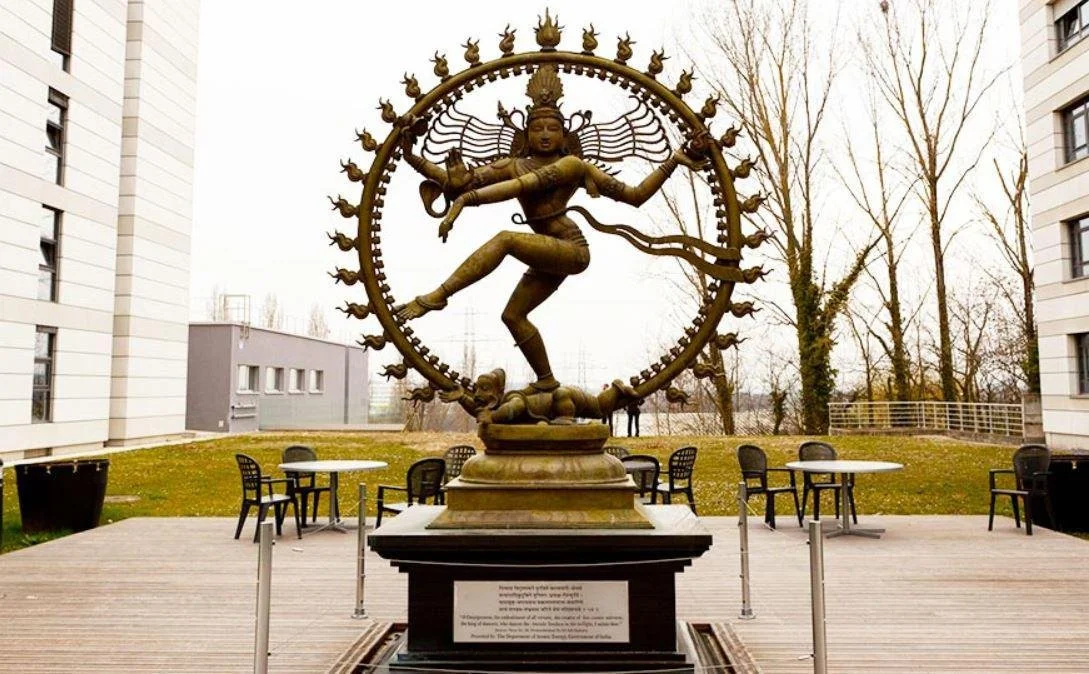
The statue of Nataraja at CERN - the largest particle physics lab in the world
In the form of Nataraja, Shiva reveals that the universe is rhythm. Stars are born and dissolve. Galaxies expand. Atoms vibrate. Creation and destruction are not opposites but phases of one continuous movement. The Nada(sound) of His Damaru signifies primordial vibration; the serene face signifies inner stillness amidst cosmic motion.
The Rig Veda describes Isvara entering a Yajna and is transformed to become the universe Himself. Philosophically, this points to a profound truth: consciousness does not stand outside creation — it permeates it. The unmanifest becomes manifest.
Creation, then, is not merely mechanical. It is conscious.
II. Shiva as Consciousness: The Stillness Behind Movement
In Shaiva understanding:
Shiva is pure consciousness — the witness.
Shakti is energy — movement, vibration, creation.
When consciousness and energy unite, manifestation happens. Without Shiva there is no awareness; without Shakti there is no experience. Creation is their dance.
Movement outside. Stillness within.
That is Shiva. Shiva is not outside you. The Shiva within is your capacity to witness without being pulled into reaction. It is Chitta — pure awareness — without Ahamkara, the ego-identity.
When you observe anger without becoming anger, that is Shiva.
When you watch a thought without being trapped by it, that is Shiva.
When you sit in meditation and notice the breath without interference, that is Shiva.
Between inhale and exhale there is a subtle pause — a moment of zero movement. Creation in the inhale. Dissolution in the exhale. And in between, stillness. Meditation is entering that still point — not escaping the world, but recognizing the ground from which the world arises.
As Mahakala, Shiva is time itself. Every form changes. Every identity transforms. Yet the witnessing awareness remains untouched. This is the paradox at the heart of existence: forms are transient; consciousness is constant.
Maha Shivaratri is alignment with that truth.
It is the night we remember:
I am not merely the body.
I am not merely thoughts.
I am not merely emotions.
I am the awareness in which all of this appears.
The world is Shakti. The witness is Shiva. When they are recognized as one, there is freedom.
Tonight is not about worshiping something distant. It is about awakening what has always been present.
Sit in silence.
Watch the breath.
Witness the mind.
Enter the stillness.
That stillness is Shiva.
Har Har Mahadev.
